Teaching Platform study & check

Displacement in time

Solving $a = -\omega^2 x$ gives a displacement that varies sinusoidally with time:

\[x(t) = A\cos(\omega t + \phi)\] (1)

$A$ is the amplitude, the furthest the object gets from the middle. $\phi$ is the phase, which just says where in the cycle the clock was started.
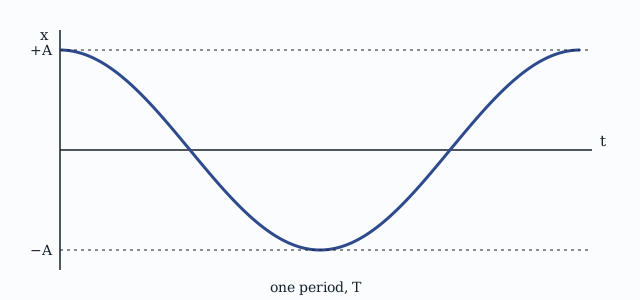
Displacement against time for one cycle, starting at maximum positive displacement.
One cycle of $x(t) = A\cos(\omega t)$, started from full displacement.
If you would rather watch one: a mass on a spring traced against a moving strip of paper.

Check yourself

Have a go. If you get it wrong you will get a hint and one more try; after that we will show you how it works.

Question 1 10 points

Complete the sentence about equation (1).

In x(t) = A cos(ωt + φ), the symbol A is called the and the period of the motion is 2π divided by .

2 attempts left
Question 2 10 points

On the graph below, click the moment where the mass is momentarily at rest — speed zero, about to turn round.

Displacement against time for one cycle of simple harmonic motion. The curve starts at maximum positive displacement, falls through zero, reaches its lowest point at the halfway mark, and returns.

Click the diagram — one place. Click a marker again to remove it.

2 attempts left